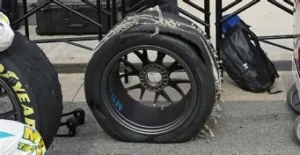
Another NASCAR incident:
At the Pheonix race, there were a lot of tire …… ah …… disablements. Road hazards are a thing and since there were some brake parts failing, it’s inevitable. But there were quite a few tire issues, and given that it was pretty warm, some of them had to be tire structural failures. Here’s what I know about how this works.
In street tires, the belts have a rubber insert between the layers of the belt plies to postpone the onset of fatigue failures. In race tires, they only have to last a few miles. Sometimes double digit miles, and sometimes a hundred or a hundred and a half. In this case it was the latter.
But adding more rubber makes the tire thicker, and thicker = more heat = the sooner the failure due to heat. It’s a balancing act. When racing conditions are different than the testing conditions, tire failures can happen. And in this case, it’s more horsepower. The teams that pushed the boundaries, sometimes overstep them. Less inflation pressure, more camber, etc. contribute to speeding up the process.
I am of the opinion that all tires eventually fail – it’s just that the tire should be designed to fail AFTER the tire has been removed. This has been a problem for as long as there have been tires.
******************************************
Bridgestone just launched a new line of tires designed for Motorhomes – Duravis Camper All Season. Interestingly, I picked up on this on a news site specializing in tires in the UK.
The tire line has the Alpine symbol (3PMSF), which would make it an “All Weather” tire, so I wonder why they named it “All Season”. It also has a new marking I had never heard of – “CP” – standing for “Camping Pneu”. It appears this marking comes after the size, and would make me think there is some new identification from ETRTO – European Tyre and Rim Technical Organization. The fact that the word “Pneu” is used, instead of the word “Tire” adds credence as “Pneu” would be recognizable in any Romance language (languages derived from Latin which the Romans spoke) – meaning French, Spanish, Portuguese, and Italian.
HOWEVER, this makes no sense to me as these kinds of tires already exist in the “Commercial” section of ETRTO’s yearbook. I wonder if this is something the marketing folks at Bridgestone made up. Here’s a very blurry imagine, taken from the photo of the tire.

*********************************
In that same issue, Michelin is reported to have launched an AI driven tire inspection system for truck tires called “TreadVision”, intended to help truck fleet operators decide when to pull tires for retreading and to help retreaders with the inspection process (to discard tires unsuitable for retreading). It reportedly incorporates the results of shearography, which can detect separations very early – even before they are visible to the naked eye. Normally this would mean a person had to view the shearography results, but I can see how an AI might be used to automate the process.
What I don’t understand is how this would be useful at the fleet level to decide when to remove tire for retreading. I suspect there is a multilevel computer system, integrating many separate things in one database.
*************************************************
In another article, it was reported that 75% of the UK tire recycling shipments didn’t meet the environmental standards issued by the EA (Environmental Agency). It was unclear, but the EA must be part of the UK government.
In particular, tires are being sent to India to be pyrolyzed – a process of heating the tire to break down the rubber. It is my understanding that this process releases large amounts of sulfur compounds, so it is banned in the UK, but not in India. It isn’t the fact that the tires are being sent to India, or that India allows pyrolyzation, it’s the fact that the tires are still full of pollutants, and the regulations specify that even exports have to comply with anti-pollution regulations. In other words, the UK government wants pollution problems created in the UK to be handled in the UK and not exported to someplace else where the regulations are less strict!
********************************************
And a comment about tire factories, prompted by the announcement that Yokohama is closing its Salem, Virginia production facility.
They have been closing tire factories for my entire 40+ year career in the business. There’s a lot of gnashing of teeth and finger-pointing, but the bottomline is that factories don’t last forever – they reach a level where it is no longer economical to update the equipment inside the plants to stay efficient.
Some of this is that governments give new factories incentives. Some of it is that some new manufacturing techniques require a different layout – ones that require a major, and expensive reorganization of the work flow.
As a reference, multi-story factories were replaced by same level factories with straight through work flow – that is one end is where the raw materials cam ein and the other end was where the finished product came out. At worse, a “U” shape was used if there was enough room.
Another part of the problem is that Unions tend to be very resistant to change, and make things difficult for management to implement changes. On the other hand, if left unchecked, management will exploit the workers.
It’s a sad fact of life.
*************************************