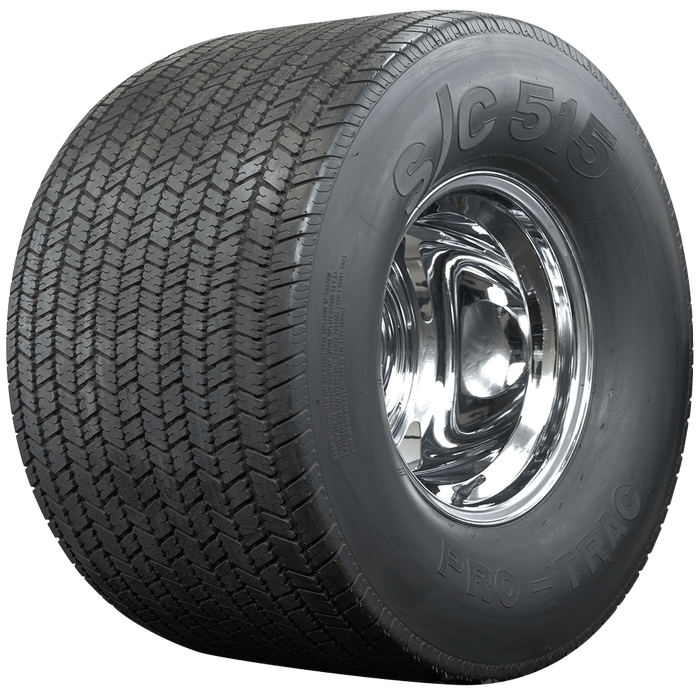
This time it’s tire sizes that aren’t covered by a tire standardizing organization.
445/50-15 & 515/45-15
I stumbled across 2 tire sizes I was unfamiliar with. The tires are 445/50-15 and 515/45-15 Pro-Trac Street Pro – apparently made by Coker Tire and sold by a few other outlets, like Summit Racing.
The 445/50-15 is 17.8″ (452mm) wide with an allowable rim width range of 12″ to 14″ (which I take to mean 13″ is the width of the measuring rim) and an overall diameter of 32.5″ (825.5mm). I didn’t find any info on the max load nor inflation pressure.
If I do the calculation, the aspect ratio is 49.2%.
The 515/45-15 is 20.7″ (525.8mm) wide with an allowable rim width range of 14″ to 16″ (which I take to mean the measuring rim is 15″). This one has a max load of 2910# (1320 kg), but, again, no information about the inflation pressure. The calculated aspect ratio is 43.0%.
The construction is listed as poly/fiberglass bias ply. The problem with that is Goodyear used to produce a tire called PolyGlas, which was a bias belted tire to compete against other polyester/fiberglass bias belted tires of the era (late 1960’s, early 1970’s). While it is possible that this tire is indeed a bias ply tire with a fiberglass breaker (same angle as the plies), given the low aspect ratio and width of the tread, my best guess is that this is a bias belted tire (the belt being a different angle than the plies.)
Here are links to a webpage: Pro-Trac Street Pro 445/50-15 Tire Pro-Trac Street Pro 515/45-15 Tire
I do not think Coker Tires is a manufacturer, per se. I think they have tires made for them. That would make them a Private Brander. Nevertheless, they appear to be the party responsible for meeting the regulations.
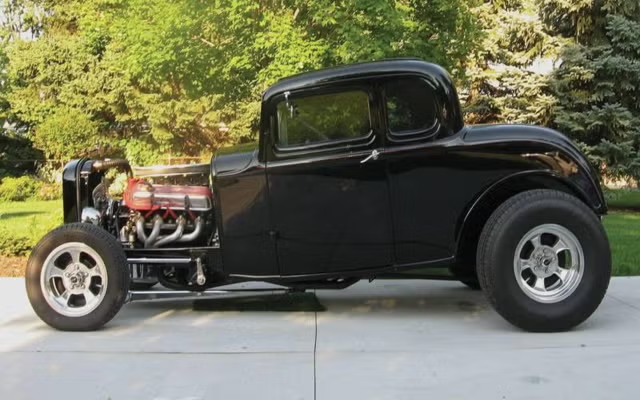
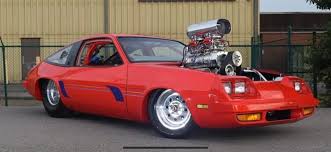
These tires are designed to be used on custom cars – especially Hot Rods and Pro Street. The idea is to mimic rear drag racing tires – big and wide!
Here’s the kind of vehicles such a tire is designed for.
I am publishing this webpage because these tires bring up quite a few issues:
- Could the tire be exempt from US government regulations due to low production volume?
Sort of! In researching, I don’t find any minimum production figures in the regulations. HOWEVER, Google’s AI seems to think so, and cited the same regulation I had been looking at. So be careful. AI’s might be getting this wrong.
But normally, tires with production figures below 15,000 per year are exempt from all kinds of regulations. I note that Coker doesn’t list the UTQG ratings – maybe because they don’t have them because they are exempt? I’ll keep digging to see there is an exemption for low production values.
2. Is the tire covered by the normal tire standards?
I couldn’t find the tire size listed in TRA, ETRTO, or JATMA. It might be part of another standard from another country, but I doubt it. Coker says the tire was made in the US, which means it would normally be covered by TRA, the US tire standardizing organization – HOWEVER – TRA uses the letter “P” in front of the tire size, so this whole thing is a bit weird.
3. So how did the manufacturer decide what load, inflation pressure, etc. to put on the sidewall?
This is exactly why I am publishing this webpage as this is an interesting wrinkle on things.
The Tire and Rim Association has a “Members Only” section that includes, among other things, the formulas to calculate load carrying capacity. I assume Coker Tire is a member. (I looked up in the 2025 TRA Yearbook and Coker Tire is not listed anywhere in the book. Not even a corresponding member – one on the mailing list!)
I note that the US Tire Manufacturers Association also doesn’t list Coker Tire as a member. Another indication that these tires are manufactured FOR Coker Tire.
My best guess is that whoever is manufacturing the tires for Coker, is a TRA member and has access to that formula.
4. What about DOT testing? What about UTQG ratings?

I suspect that these 2 tires have to meet the DOT testing requirements – which means 1) Bead Unseating Test, 2) Tire Strength (Plunger-Energy) Test, 3) Tire Endurance /Low Inflation Test, and 4) High Speed Test. Here’s a link to my webpage on the subject:
DOT Testing – Barry’s Tire Tech
I also suspect the tires are exempt from UTQG ratings. Thus far, I haven’t been able to any ratings for these.
One of the peculiar things about this is that US regulations allow tires not listed in tire standards manuals to be produced PROVIDED certain information is published and generally available. I can’t seem to find where these are published, so I wonder if there is a document that Coker Tire has that can be produced when asked.

5. What about the Serial Number?
Obviously the plant has a code assigned by NHTSA. The size code can be anything the tire manufacturer says, so long as there is a list somewhere. The type code is assigned by the tire manufacturer. The date code has to be in a week/week/year/year format.
That means it would be easy to make a serial number coding.