This article is about Winter and All Weather tires. It includes information about the tests involved.
| Winter and All Weather Tires: Updated January, 2026 I added a line or 2 about studded tires below. Updated Apr, 2024 In the Apr 8, 2024 issue of Tire Business, a trade newspaper for the tire industry, there was an article indicating that “The Wheel Group”, a company in California which distributes tires, has halted sales of its AMP brand non-mud-terrain tires because they didn’t meet the US and Canadian standards for the Alpine symbol (aka 3PMSF). The tires did meet the European standard. As noted below, there are 2 tests that can be used for the symbol. What I didn’t know was that the US and Canada don’t approve of the ABS braking test (aka UN ECE R117) . They only accept the ASTM F-1805 test. Interestingly, the tires were tested using F-1805 and they failed! Apparently, they are planning on recalling the tires. I updated the text below to reflect the fact that the US and Canada only accept the ASTM test. Revised Sep, 2023: I found a chart on snow traction. I also found a copy of F-1805 and it included a chart showing the coefficient of friction for the SRTT for various surfaces. Update: Nov, 2022: 3 items: The EU has authorized another test for the Alpine symbol – an ABS braking test at 107% of the SRTT. Apparently I found a copy of a proposed EU regulation that stipulated an acceptance level for the Alpine symbol at 125% of the SRTT. That is incorrect. I’ve corrected the value to 110%, just like North America. I have deleted my commentary about the problems that difference would have created. The EU has apparently released the test method and criteria for the Nordic symbol – ABS braking, indoor or outdoor, at 118% of the SRTT. |
What you should get from this page:
- ALL Winter tires have an Alpine symbol (aka 3PMSF)
- The symbol indicates that a tire passes a one of 2 snow traction tests.
- There is a US/Canada Test – ASTM F-1805.
- There is a European Test – UNECE R117,
- The acceptance levels are such that the US/Canada test is slightly more difficult.
- Winter tires do NOT have UTQG ratings.
- The symbol indicates that a tire passes a one of 2 snow traction tests.
- There are tires that are NOT Winter tires that may also pass the test for the Alpine Symbol.
- All Season tires that pass are called “All Weather” tires.
- There is no name for All Terrain tires that pass the test.
- There is a symbol for Ice Traction, sometimes called the “Nordic Symbol”.
- It is generally recommended that Winter tires be replaced when they reach 5/32nds of an inch (4mm) tread depth remaining, although you will see some recommendations at 7/32nds of an inch (5.5mm).
- Some locales have regulations for 5/32nds (4mm).
- Studs are banned in some locales
- Some totally ban studs
- Some only during certain parts of the year.
Please Note:
I am only going to talk about passenger car tires. I am not going to talk about Light Truck and Truck/Bus tires (sometimes referred to as Medium Truck tires) which are also covered by test methods to get the Alpine symbol – but their criteria is slightly different.
I am also not going to talk about studded tires. I have very little experience with studded tires. But here’s a link to a Wikipedia article on snow tires that has information about studded tires and where/when they can be used:
Updated January, 2026
I stumbled on a summary on studded tires from the state of Washington.
Summary:
- A Washington State study (October 2002) of available data concluded that studded tires didn’t add enough safety to justify allowing them, given the damage they do to road surfaces, and recommended banning them – which would be a change from their current position of allowing them from November 1st to April 1st.
- They acknowledged that there is a pavement wear issue for studded tires, but research this issue.
- Studded tires are superior to other types of tires only on relatively smooth ice surfaces and snow near the freezing point. This is a narrow window of conditions that don’t occur very often.
- To my knowledge, Washington State did not act on this recommendation.
The source report and a later fact sheet are linked below:
Studded Winter Tires – Barry’s Tire Tech
/end update
So far, I haven’t found any tests of tread depth vs snow traction and ice traction. When I do, I’ll publish it here.
I am sure that snow traction decreases as a tire wears. Maybe the same for ice traction?? Most sources claim that 5/32nds of an inch (4mm) is when winter tires should be removed and I see no reason to amend that. I’ve seen a couple of places where 7/32nds (5.5mm) is recommended – among these is Transport Canada.
I haven’t seen any place that comments on tread depth and ice traction. Obviously smooth is bad, but one would think that snow traction gets bad sooner than ice traction. I hope to find data to support that.

This is the 3PMSF (3 Peak Mountain, Snow Flake) symbol, also known as the Alpine symbol (pronounced al-peene). EVERY Winter tire has to have this symbol. It means the tire has passed a certain snow traction test (either ASTM F-1805 or UNECE R117).
For the ASTM F-1805 test, the traction value must be 12% better than the new SRTT (Standard Reference Test Tire) – it used to be 10% for the old SRTT. For the UNECE R117, the value is 7%.
If the tire doesn’t have this symbol, it can’t be considered a “Winter” tire.
Please note: I am going to use the term “Alpine Symbol” from this point forward. I think it is easier to use than 3PMSF

Some other types of tires MAY also display the Alpine symbol. The only requirement is that they pass one of those tests.
All Season tires that do so are called “All Weather” tires
– BUT –
according to Tire Rack, those 2 words are trademarked by Goodyear, which means that those words can not be used in any commercial way – as in a name. That also means that there can’t be a category “All Weather”, so you will find such tires under the “All Season” umbrella.
Frequently the letters AW, or A/W, or A-W are used in place of those words to avoid the trademark infringement.
Also most All Terrain tires can pass the test and some display the symbol, but to my knowledge, there is no special designation for those. (Maybe later?)
The Test:
ASTM F-1805
In February, 1999, the RMA (now the USTMA – US Tire Manufacturers Association) and the Rubber Association of Canada (now TRAC – Tire and Rubber Association of Canada) jointly announced an initiative to provide a way to easily distinguish winter tires, based on a request from the Canadian government. This had been in the works for several years before the announcement
The ASTM = American Society for Testing and Materials (Now called ASTM International) published the test. They publish tests and test standards for many industries, including the automotive (and therefore tire) industry.
Note: The photo is of an old instrumented truck where the right rear position is instrumented. Crude, but effective!
The test is an acceleration test conducted on a prepped snow surface.


Yes, the snow is prepared!
And there are specs the prepped snow has to have! That is why it took so long to develop a snow traction test.
It is reported (but refuted) that Eskimos have 50 words to describe snow. Is snow dry and powdery, or wet and slushy? That is a problem when you are trying to test tires in snow.
The good news is that the prepped snow is reproduceable. This is a major reason why it is done this way.
The test measures the peak traction during acceleration. I assume they did not chose a braking test because the snow might pile up in front of the tires and affect the results.
While the result is a traction number, snow traction testing is so highly variable that the results are compared to the SRTT (Standard Reference Test Tire). That means that every test has to include an SRTT in the mix and there is part of the procedure that deals with how that is done.
To get the symbol, the tire being tested must exceed the traction of the old SRTT by 10%. (now, 12% for the new SRTT!)
Why 10% 12%? Because when they initially set up the procedure, they didn’t have much in the way of historical results, and that value seemed appropriate. I talk below about what problems that has created.


The Other Test:
UN ECE R117
In May of 2021, the EU (European Union) changed their regulations for tire labeling, and part of that change included adding the Alpine symbol. They also added an ABS braking test with an acceptance level of 107% of the new SRTT.
All 4 tires have to be the same – unlike F-1805 which uses one tire.
The test is conducted from 25 kph to 10 kph (15 to 6 mph).
| Update Apr, 2024 Apparently, the US and Canada don’t accept the European test (UNECE R117) by itself. To get the designation in those 2 countries, the tire MUST pass the ASTM F-1805 test – unlike the regulations in Europe (and elsewhere?) where the tires must pass either test. There was at least one situation where tires passed the European test but not the US/Canadian test. So if you aren’t in the US and Canada be aware of this! |
There is no ice traction standard to get the Alpine symbol.
That’s because, at the time, there wasn’t a good way to test on ice. That has since changed.


This is the “Ice Grip Symbol” that was created by the May, 2021 revision to the EU regulations on tires. I’ve heard it called the “Nordic Symbol”, but that doesn’t seem to be common usage. (Yet!!)
Much like the Alpine symbol, this symbol requires passing a test, which consists of braking on a smooth ice surface, indoor or outdoor, and the results are compared to the SRTT. (Have you noticed how often the SRTT appears in tire testing?) The test is ISO19447.
Initially, the regulations didn’t specify a criteria, but that has changed. According to the latest ads from Nokia, the threshold is 118% of the SRTT – and the test is very similar to the braking test on snow.
It is my understanding that tires that do well on the ice traction test, do not do well in the wet traction part of the EU regulation, so it is intended that tires with this symbol are only suitable for Nordic countries (Norway, Sweden, Finland, etc.).
I can not help thinking there are other places where tires of this sort might also be useful (I’m looking at you, Canada!), but I have not heard of any movement in those locales.
Please note: The US and Canada don’t recognize the Nordic Symbol. I suspect that means that tires can have those symbols, but they aren’t regulated in those places – unlike the Alpine Symbol.
| ALSO: Winter tires will NOT have UTQG ratings. They are exempt! So no treadwear ratings, nor traction ratings (except for the EU ratings). All Weather tires are not exempt since they are basically enhanced All Season tires |

The Science:
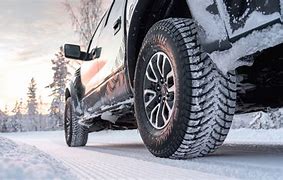
Snow traction is mostly about edges – and that means lots of sipes (Paddle wheel effect). Notice all the sipes in the photo. If you remove those sipes (and the studs!), you get an all season pattern!
Tread compound? Has to be soft at winter temperatures – which means it is too soft for summer.
That means that winter tires are NOT suitable for summer usage.
I do not subscribe to the hydrophobic/hydrophilic (water attracting) theory of tread compounding. I think that is mostly marketing hype. Rubber is a hydrocarbon and so is oil – and we all know about oil and water.
What about All Weather tires?
They would be compounded for higher temperatures, which goes back to edges!
All Terrain tires?
They pass the test just due to their tread pattern.

Revised Sep, 2023
In the September 11, 2023 issue of Tire Business, a tire industry newspaper, they had an article on Smithers and snow traction testing. It included a chart showing traction levels for various snowy surfaces – below.
Please note: There is an error on the line for Chloride-treated Snow. The range should 0.35 to 0.45 – obviously.

At the same time, I stumbled across an on-line version of F-1805: I downloaded it:
Below is a screenshot of part of the F-1805 test standard showing a table that has coefficients of friction for the SRTT on various surfaces.

Here’s the SRTT data from that table:

Note: Medium pack snow has the best coefficient – and it’s larger than soft pack snow! But beyond that, as the snow gets more packed, the lower the coefficient.
Also, that chart isn’t much different than what was published in the Sept 2023 Tire Business article.
/end Sep 2023 Revision

History:
When radial tires were introduced in the 1960’s, it became apparent that they had better wear characteristics than regular bias tires. That meant that tire designers could use more aggressive tread patterns and not suffer wear issues. Eventually, SOME radial STREET tires had very nearly the snow traction of the commonly used “Snow Tires”.
Many tire manufacturers started producing such tires under the “All Season” umbrella.
This created a problem in California where the California Highway Patrol required “Snow Tires” or chains on certain highways during certain inclement weather. CHP requested a way to tell what was and what was not an All Season tire.
At the time, snow traction testing was in its infancy – not reliable and not repeatable.
So the RMA (Now the US Tire Manufacturers Association) created a verbal description of what an All Season tire was and allowed tire manufacturers to use the letters “M” and “S” with some sort of divider between those letters, such as “-” , “/”, “+”, etc. You can see that today on all All Season tires.

Here’s a link to the verbal description of what is required to get the “MS” symbol:
USTMA Snow Tire Definition for Passenger and Light Truck Tires – 2024 version
What I find interesting is that in spite of the shortcomings of the “MS” symbol, snow tires basically disappeared from the US market for about 20 years (except for a few locales).
Over the years, consumer’s expectations for snow traction has grown – as well as the tire manufacturer’s ability to deliver better snow traction. Needless to say, the “MS” designation just doesn’t work anymore.

In the mid 1990’s, the Canadian government approached the Canadian Rubber Manufacturers Association (now TRAC – Tire and Rubber Association of Canada) and asked them to develop a definition for a Winter Tire. They needed it because they intended to require “Winter Tires” in certain locations and during certain times of the year and they needed a simple way to identify them. (Sound familiar?)
The CRMA collaborated with the RMA (Rubber Manufacturer’s Association, now the US Tire Manufacturers Association) and ASTM (American Society for Testing and Materials, now ASTM International.) to develop a test and a symbol that could be put on every qualifying tire.
But this time snow traction testing had progressed quite a bit, so they came up with the test mentioned above. And the 3PMSF symbol.
HOWEVER, time has proven that this also is inadequate.
Not only are too many non-winter tires able to pass the test – much to the chagrin of the Canadian government – but tire manufacturers have improved snow traction even for winter tires.
An attempt was made to expand the Alpine symbol to include a graduated rating system for both enhanced snow and for ice traction, but what is needed for ice traction is quite different than snow traction, so it was abandoned.


Initially, the Europeans didn’t like the symbol. I suspect a bit of “Not Invented Here!”. But they have warmed up to it and adopted it in their new (May, 2021) tire labeling regulation.
In addition, there is a new symbol, tentatively labeled the “Nordic Symbol”, to indicate enhanced ice traction – and a test to go along with that. It is not yet clear how EU countries will deal with that, but the intention is for it to apply only for Norway, Sweden, Finland, etc. – the so called “Nordic” countries.
I do not have information for other parts of the world.
| Update Nov 2022: I found an EU Tyre Registry that has the tire labels. However, they are not summarized. You have to look at each label individually: EU Product Registry – Tyres Update Jan 2024: I stumbled across an article from Consumer Reports that says that All Season tires lose 14% of their snow traction when half worn: Make Sure Your Tires Have Enough Tread for a Snowy Winter – Consumer Reports – Archived Version They also report that there is only a little degradation in ice traction for half worn All Season tires. |
| Update Mar, 2024: One of my favorite YouTube channels is Tyre Reviews with Jonathon Benson. He did a test of 5 different tires at different temperatures, trying to establish if the quoted 7°C crossover point was true. (Hint: He did!) But there was one graph that jumped out at me – and it was the one where he verified the 7°C crossover temperature: |

Notice that there is group of 3 tires at the bottom that are more or less behaving the same, and 2 tires doing something different. In particular the Summer tire was pretty bad for wet braking at cold temperatures (as expected), but got better as the temperature went up.
But the Nordic tire was bad and stayed bad! At least for wet traction.
This testing was done before the Ice Grip (Nordic) Symbol was used on production tires (2019), but this seems to verify that wet traction is indeed an issue for these types of tires. I wonder what is going to happen in North America when the symbol becomes common – in particular, will Nordic tires get a reputation of having wet traction issues and thereby hurt sales?
Here’s a link to the video:
The TRUTH About Winter, All Season and Summer Tires ❄ Tested at 0c, 2c, 6c, 10c, 15c