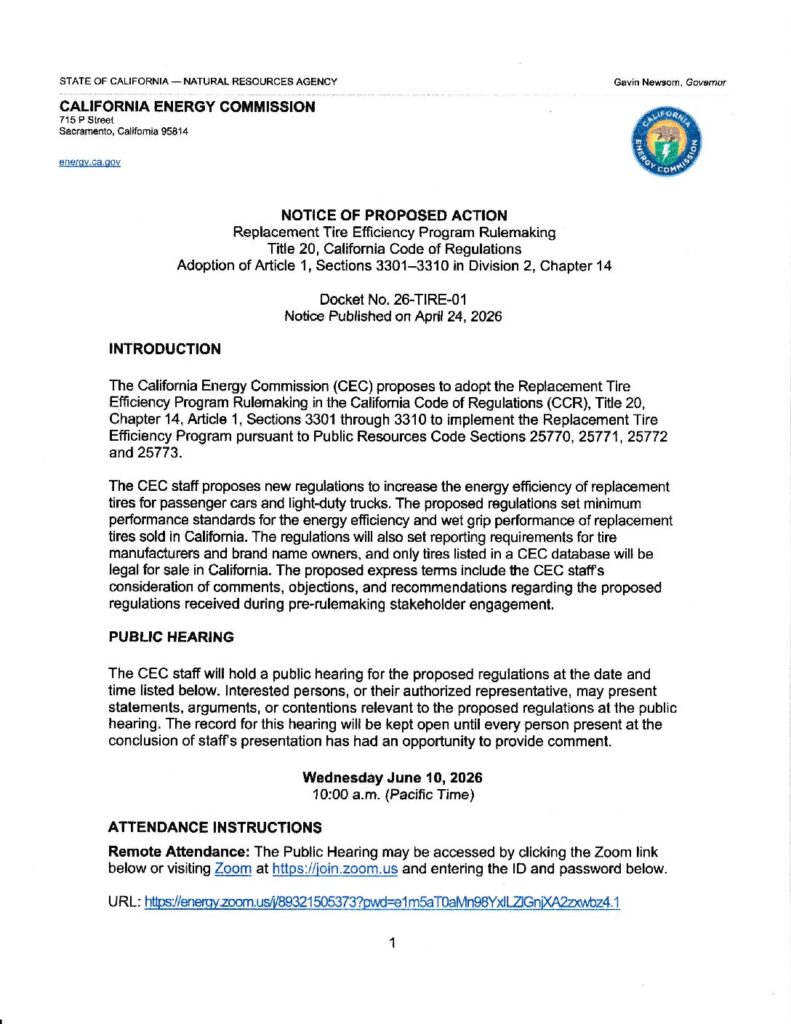
Update July 15, 2026: The CEC issued a transcript of the comments:
There were several comments that are interesting.
John Baldwin of Discount Tire said that if the Phase 2 limits were implemented today, 70% of the tires currently on the market would be banned. (Page 66).
Jay Spears of Continental Tire said there were over 50,000 SKU’s and he wondered how enforcement could be done with that volume of data points. (Page 72).
The meeting adjourned at 12:14 pm (Local time) meaning the meetting was 2 hours 14 minutes long.
/end July update
Update: June 20, 2026: The US Tire Manufacturers Association has issued a written comment. You can find it here:
See the end of the article for details of the USTMA suggested changes.
/end June update
Pre-hearing:
On June 10, 2026, the California Energy Commission will hold held a public hearing on their proposed tire regulations. The hearing is slated to last from 10:00 am local time (PST) to 6:00 pm. I do not expect the meeting to last that long. I don’t know how long the meeting lasted, but I only lasted 90 minutes before I got bored! The meeting lasted 2 hours and 14 minutes (See July update above!)
Here’s a copy of the full notice. It’s a bit long!!
Notice of Proposed Action: Replacement Tire Efficiency Program Rulemaking
Here are links to previous postings on those regulations:
An Archived version of my posting on the Feb, 2023 Notice – Note, because this is an archived version, there are few photos.
Expectations:
I expect the US Tire Manufacturers Association (USTMA) to estimate how many tires would NOT meet the proposed regulations.I don not think that happened, especially considering that the comments were limited to 3 minutes.- I expect several other organizations to object in some way.
- There should be several organizations of tire retailers and the like.
- So far, the latest CEC summary of the regulations haven’t detailed what has to happen at the retail level. I suspect that means there have been no changes.
- There should be several organizations of tire retailers and the like.
- I expect many environmental organizations to praise the regulations – frequently commenting on things that are NOT true!
Editorial Note: This is the way government should be run. Allow the public to comment on proposed regulations with enough time to change things, if needed. This is, after all, YOUR government!
What actually happened!
The meeting was a chance for the public to comment on the proposed regulation. They started off with a 20 minute presentation summarizing the proposed regulation.
One item jumped out during that presentation: The Ultra High Performance Tire category not only required tires to be W or Y speed rated, but also have a 1.45 wet traction index. That wet grip index was there before, but I had not noticed it. This is important, which I will outline below.
The meeting was then opened for comments for those who attended the meeting both on the phone and via Zoom. The commenters were limited to 3 minutes – and there was a display countdown clock. They meant this to alert the commenters that they intended to enforce the time limit.
While a written document could be submitted which had no limit to its length, only the verbal comments were time limited.
There were a few notable commenters: A rep from Michelin, several reps from dealer groups, several environmental groups reps, but the surprising thing was how many private citizens wanted to comment.
With a few exceptions, the comments were in favor of the regulation. The ones who weren’t were more concerned about the effect the regulation would have, rather than being strongly opposed to it. Overall, everyone was respectful and kept to the time limit.
There was one lady from San Diego who was in favor of the regulation, but was confused about the situation. She wanted to know why if there was no downside to the regulation, why the regulation was necessary. I will address this immediately below:
The reason she was confused was that the commission did a good job of painting a very favorable and rosy picture. They presented the data they had displayed before that showed no correlation between rolling resistance and treadwear, and no correlation between rolling resistance and wet traction.
UNFORTUNATELY, that analysis was a 2 dimensional analysis – that is, it was looking for a correlation between 2 factors, completely ignoring that the issue is multi-dimensional.
To wit: For years the tire industry has been referring to what I call a technology triangle with rolling resistance, traction, especially wet traction, and treadwear. To complicate matters further, Rubber chemists have been hard at work to change the relationship (meaning to make a tire with lower RR, without adversely affecting treadwear and/or traction.) To do a 2 dimensional analysis is to miss the whole picture.
What I find very interesting is that in spite of the commission not acknowledging that there is such a relationship, their latest version of the regulation addresses that triangle by creating special categories for long wearing tires, and high wet grip tires. (Please note, that I had totally missed the fact that the category for W and Y speed rated tires included a high wet grip requirement. This now makes perfect sense to me.)
There is a provision for people to submit comments in written form. There have been several negative comments, but very few of those were more than “I don’t like it!”. That is none had substantial information from which the commission could justify a change in direction.
Final Verdict!
I expect this regulation to go forward as planned and on schedule – First implementation Jan 1, 2028. Update July 15, 2026: Given the number of SKU’s that would be banned, I expect the commission to further refine the regulation. /end update
My Concerns:
The first version of the regulations, revealed February 14, 2023, was challenged by the US Tire Manufacturers Association (USTMA). They estimated that 76% of tires currently on the market would be banned during Phase 1, and 99% for Phase 2! I haven’t seen an estimate for this (second?) version.
I realize that the USTMA gave the commission a HUGE!! file (7,400 lines) on the condition of confidentiality. I suspect it would be violating that confidentiality for the commission to reveal THEIR estimate as it would be based on that data – BUT – I think the USTMA can!
But my gut tells me that if the first version banned 76% / 99%, then this version must be in the double digits (as in, at least 10%). I think anything larger than 10% would be unacceptable.
Further, the folks most affected would not be members of the USTMA. The USTMA has the largest tire manufacturers in the world, and none of what I call 3rd Tier. Besides, those 3rd Tier tires would be “owned” by importers, not the manufacturer. They are just not in a position to have a large lobby due to the available finances!
Nevertheless, I am in favor of some version of this regulation. It is a good step in providing the public with information that would previously have been unavailable – that is, the proposed TRRED database.
Update: June 20. 2026 – USTMA Comments:
On June 17, 2026, the US Tire Manufacturers Association issued a written comment on the proposed regulations. Unlike most other comments, the USTMA was very specific as to what they thought should be changed – and WHY!! I am including those comments because they are thoughtful and the suggestions are more than “I don’t like it!!” Here’s what they suggested:
- They left it to their members to comment on the goals themselves. Be aware that their members include the largest tire manufacturers in the world. To wit:
- Michelin
- Bridgestone
- Goodyear
- Continental
- Pirelli
- Yokohama
- Toyo
- Kumho
- Hankook
- Nokian
- Giti
- They suggested that ALL Original Equipment (OE) tires be exempted. They did that because some OE tires would exceed the limits and that seems counter to the intent of AB 844.
- Postpone the regulations for LT and C type tires until such time as the wet traction issues are resolved. Currently, the international test standard is still being worked on.
- Consider creating a “Long Life” category for LT and C type tires.
- Treat LT and C type tires as equivalent.
- Exempt street legal race tires. Many racing organizations require DOT rated tires for certain classes. Those tires are low production, but are only intended for competition purposes.
- Requested special attention to enforcing the “Low Production” exemption as it has the potential to be abused.
- Requested that “All Weather” tires – “All Season” tires that pass the Alpine test (aka 3PMSF) – be exempted as “Winter” tires. Winter tires are currently exempted.
- Requested that a representative sample of a particular tire line be tested, rather than every SKU to demonstrate compliance. This would reduce the amount of testing required. This would include not only different sizes, but also different make/models provided they are otherwise the same.
- That compliance testing done by outside agencies be given an error margin before declaring a tire to be in non-compliance.
- That compliance testing be fair to both domestic producers (their members) and importers.
- That the effect of Phase 1 implementation be studied before allowing Phase 2 to be implemented.
/end Update: