Update: Aug 1, 2026: On July 17, 2026, the California Energy Commission issued some changes to their proposed tire regulations. I’ve updated this webpage to show those changes – with a strikethrough (strikethrough) for the old verbiage and bolded italics (bolded italics) for new verbiage!
Here’s a link to the Docket. The one of interest is document 271526 Dated July 17, 2026: It’s a pdf.
California Energy Commission : Docket Log
I put a copy at the end of this article.:
Here are the major changes:
- Phase 1 implementation postponed from January 1, 2028 to January 1, 2029
- Phase 2 implementation postponed from January 1, 2031 to January 1, 2033
- 13″ tires are now exempt.
- It was clarified that the implementation dates apply to date of production!
- All Season Winter tires (aka All Weather tires) are now exempt.
- Competition tires are now exempt.
- Changed the definition of a “Long Life” tires from 1,000 UTQG test score to 800.
- Changed the definition of a “Ultra Long Life” tires from 1,400 UTQG test score to 1,000.
************************
************************
On April 24, 2026, the California Energy Commission (CEC) released their proposed regulations concerning the rolling resistance of tires sold in California. This is a followup on a proposal made in February, 2023.
Here’s a link to the actual proposal:
Californias Proposed Replacement Tire Efficiency Program
Here’s a summary (details further down):
- All applicable passenger car and light truck tires would be required to have rolling resistance values below a certain level in 2 phases: Please note the dates apply to date of production.
- Phase 1:
January 1, 2028January 1, 2029 - Phase 2:
January 1, 2031January 1, 2033 - Requirements vary by the type of tire
- Phase 1:
- The tires included would have to have a minimum wet traction value by Phase 1.
- Tire manufacturers (or brand owners) would be required to supply data to the CEC broken down by make/model/size in Phase 1. Some of the data includes:
- Rolling Resistance Coefficient
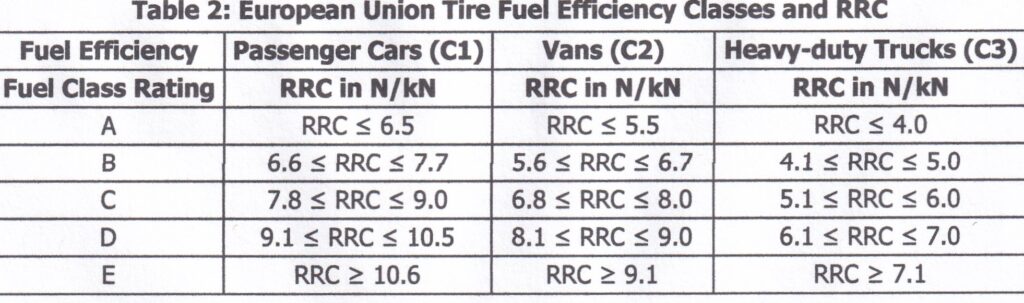
- “Leaf” rating – which is the same as the European Union’s Letter rating – details below
- UTQG treadwear rating
- There are categories for Long Life Tires and Ultra Long Life Tires based on the actual UTQG treadwear test results. (The results aren’t actually reported.)
- Wet traction value and rating
- Tires not covered:
- Winter tires
- Added All Season Winter tires (commonly called All Weather tires)
- Low production tires (less than 15,000 per year)
- Competition tires
- Special exemptions
- Winter tires
Details:
What/Who is Covered?
- All replacement tires for passenger cars and light duty trucks (less than 10,000# GVW)
- Exempt
- Retreads
- Tires with less than 15,000 units yearly production
- As designated by brand/line/size.
- Deep tread tires
- Winter tires
- Space-saver and temporary use spare tires
- Tires with
12″13″ or less rim diameter - Motorcycle tires
- Off-Road tires
- Any tire with a load index of 122 or larger or with a load carrying capacity of 1,450 kg or more.
- Any tire with a restricted speed of 50 mph or less.
- Exempted by special request
- Exempt
What are the rules?
Rolling Resistance:
- The test is ISO 28580, which is a single point test.
- The result is a force value (RRF), but it is common to use RRC (Rolling Resistance Coefficient = RRF divided by the test load).
- Please note: RRC is a dimensionless number usually expressed as newtons per kilonewton – N/kN- newtons being the metric system unit for force.
- The result is a force value (RRF), but it is common to use RRC (Rolling Resistance Coefficient = RRF divided by the test load).
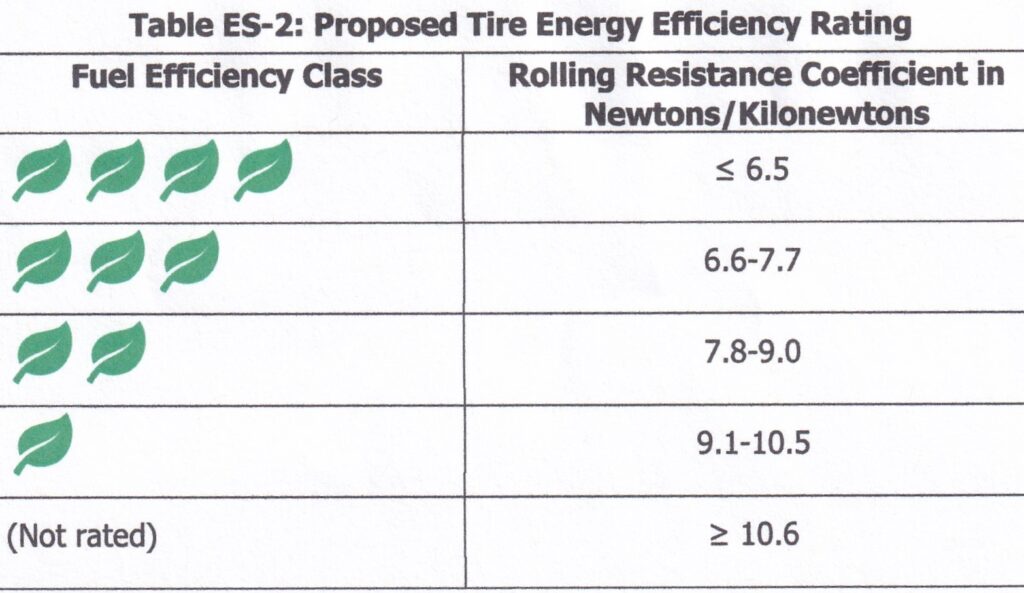
- Every tire must be “Leaf” rated according to the following:
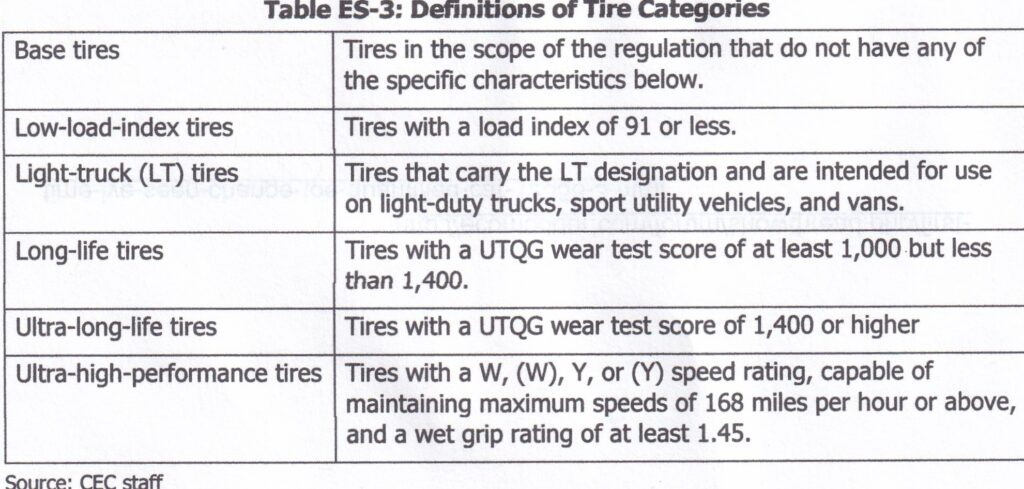
- Tires are segregated into the following categories:
- Update Aug 1, 2026: Long-life now 800 or more, and Ultra Long life 1,000 or more.
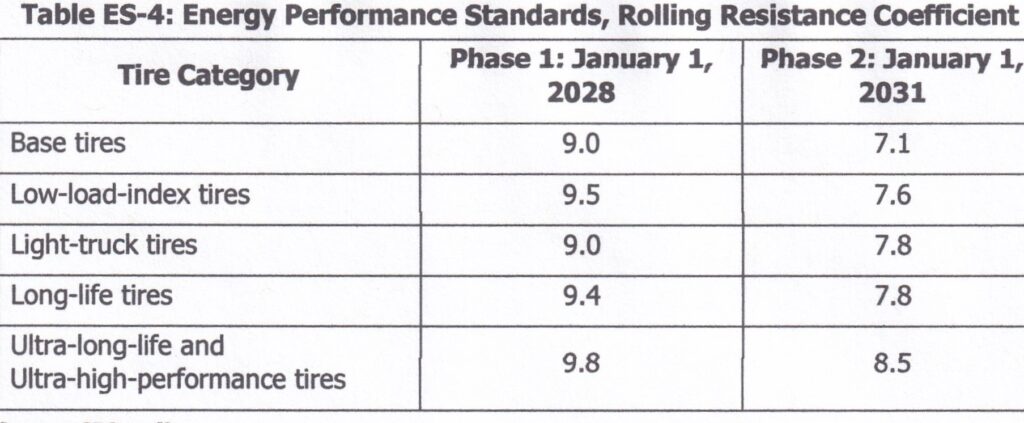
Proposed Energy Performance Standard:
Note dates are now Phase 1 Jan 1, 2029 and Phase 2: Jan 1, 2033
- The Wet Grip Minimum Performance Standard shall be 1.0 as measured by the test ISO 23671:2021. This effectively bans “C” rated UTQG Traction tires (the lowest value!).
What has to be reported to the CEC?
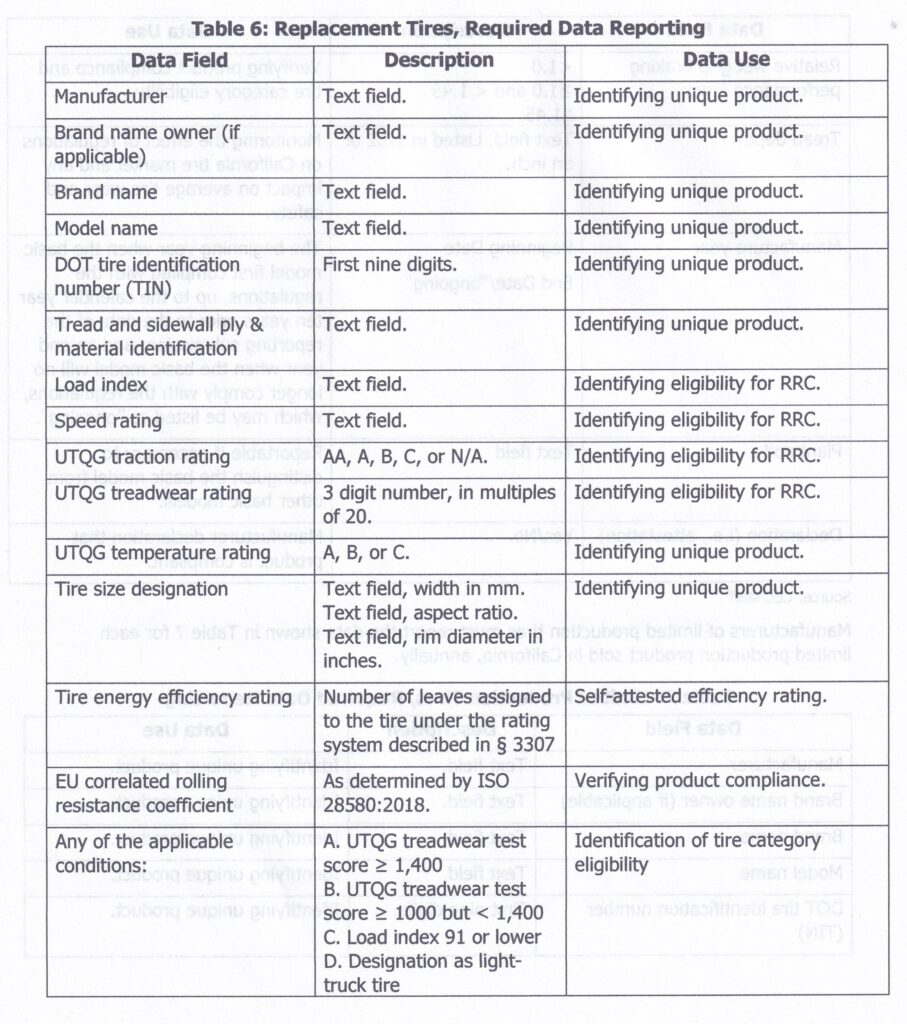
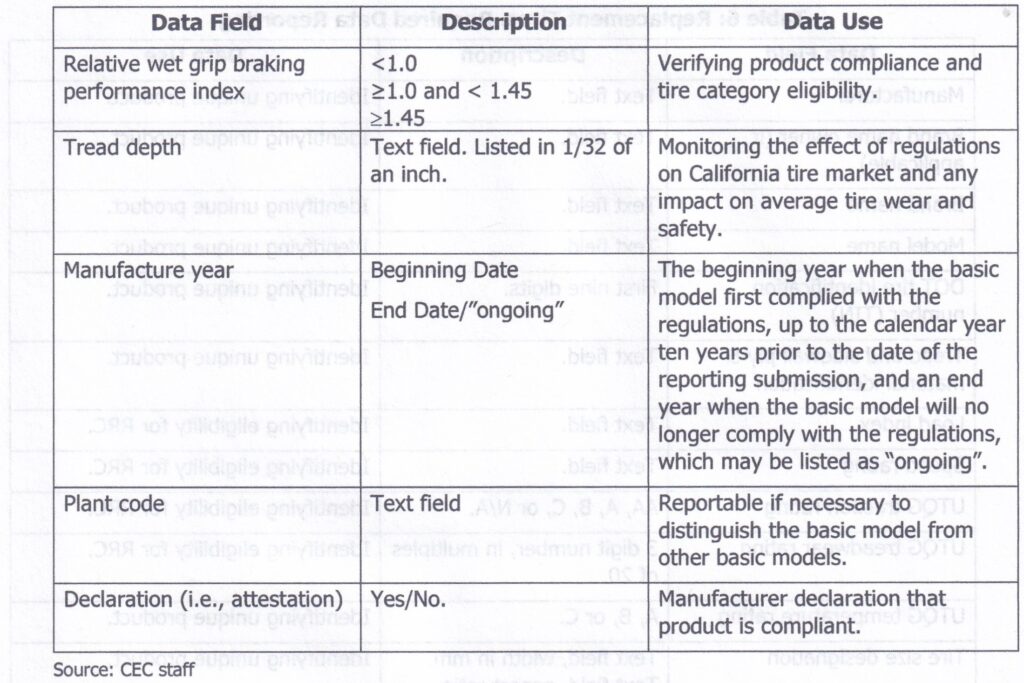
When?
On January 1, 2028 January 1, 2029, Phase 1 is proposed:
- All tires covered by this regulation must comply with the Energy Performance Standard – Phase 1.
- All tire manufacturers (or brand name owners) must supply data to the CEC, so it can be published.
- All tires covered by this regulation must comply with the Wet Grip Minimum Performance Standard.
On January 1, 2031 January 1, 2033, Phase 2 is proposed:
- All tires covered by this regulation must comply with the Energy Performance Standard – Phase 2.
Interesting Details:
- All Passenger car sizes are covered.
- Tires below 91 Load Index (that is, small tires) at a more relaxed standard.
- Most LT sizes are covered.
- Example: An LT265/75R16 LR E is 120/123 LI
- The RR rating system is the same as the European system, except this one uses “Leafs” instead of letters.
- There are different threshold levels for different types of tires. This solves a previous problem of tires with abnormally high RRC values (but not completely, so a special exemption can be requested).
- They didn’t say anything about displaying the “Leaf” rating either on the tire, on the label, nor on signage at the retail level.
- There is a system to allow exceptions for certain tires upon request. I assume they did this to fix the problem of tires falling outside the criteria that would create a shortage. I am sure this can be exploited to the consumer’s detriment.
- The database is going to include 2 categories for Long Life and Ultra Long Life tires. These tires could have UTQG Treadwear ratings beyond
1,000 and 1,400800 and 1,000 respectively, if the manufacturers chose to do so. The actual test results would not be published, only the category where such tires would fit.- Consumers might take that information and use it against tire manufacturers for warranty purposes.
- There is substantial competitive information being revealed here.
Background:
| In 2003, the California legislature passed Assembly Bill 844, which directed the commission to start a program – and I’ll quote from the Draft: “The proposed program seeks to improve the energy efficiency of replacement tires through minimum standards and improving consumer access to information to ensure replacement tires for passenger cars and light-duty trucks sold in California are at least as energy-efficient as the tires sold as original equipment on new vehicles.” The original timetable called for implementation by 2008. This did not happen. I suspect the delay was because of the HUGE!! Firestone recall in August 2000 that spilled over to affect every tire manufacturer. Plus, the timeline was optimistic even without that. |

In December 2007, the CEC reviewed some test data generated by Smithers Scientific Services at their request. Smithers is a test organization, well respected by the tire industry. They were the perfect group to conduct such tests.
Here’s a link to the presentation:
In 2009, NHTSA (National Highway and Traffic Safety Administration – a branch of the US Federal government Department of Transportation) announced they were going to issue a Federal Rule for rolling resistance of tires. The CEC decided to postpone their work to see what NHTSA was going to do.
In 2010, NHSTA published a proposed rule and the tire manufacturers objected (and in my opinion, rightly so.) The rule was withdrawn and NHTSA has repeatedly postponed the issuing of a revised rule.
So in Nov 2020, the CEC reactivated their project and the result is this proposal.
There was a workshop on Feb 14, 2023, where a proposal was introduced. Also, the USTMA (US Tire Manufacturers Association) presented their comments.
The US Tire Manufacturers Association (USTMA) pointed out that the proposal would likely ban 99% of the tires on the market at that time.
On 23 May, 2023, the USTMA applied for a confidentiality agreement for a file of data they wanted to give the CEC. That file had over 7400 lines of data. They did not specify what was in the file, but they did say that their members would only agree if they got confidentiality. They specifically said that this data wasn’t even shared with their members, which I interpreted to mean that this was the kind of data that any tire manufacturer would like to have.
What is the data in that confidential file? Best guess: RR data and all the other data CEC proposed to publish in their TRRED database (Tire Rolling Resistance Efficiency Database). As a tire engineer, I know that I would be interested in this data – even if the tire manufacturer wasn’t identified.
So here we are almost 3 years later. I suspect it took quite a bit of talk to resolve all the issues and to devise a workable plan.
Critique:
Overall, I am pleased. The CEC seems to have addressed most of the issues. I know there are always some residual issues that were missed.
There are a few issues that still need to be addressed.
I am doubly pleased that the CEC seems to have worked with the USTMA and TRAC (Tire and Rubber Association of Canada).
I am sure there will be updates. The most obvious is when the proposal is finally presented as a regulation. I am wondering what NHTSA is going to do, but given the current situation in Washington, I suspect they will take no action – even though I think they should! I think NHTSA is the proper place for this type of regulation, not the state of California (or any other state!)
Nevertheless, I applaud the CEC for taking the initiative.
Updated Opinion Aug 1, 2026: The biggest concern I have is how many tires would be banned. I can understand a few of the worst offenders, but what data is available points to SIGNIFICANT numbers!
Some Additional Information:
Here’s the latest update: July 17, 2026: