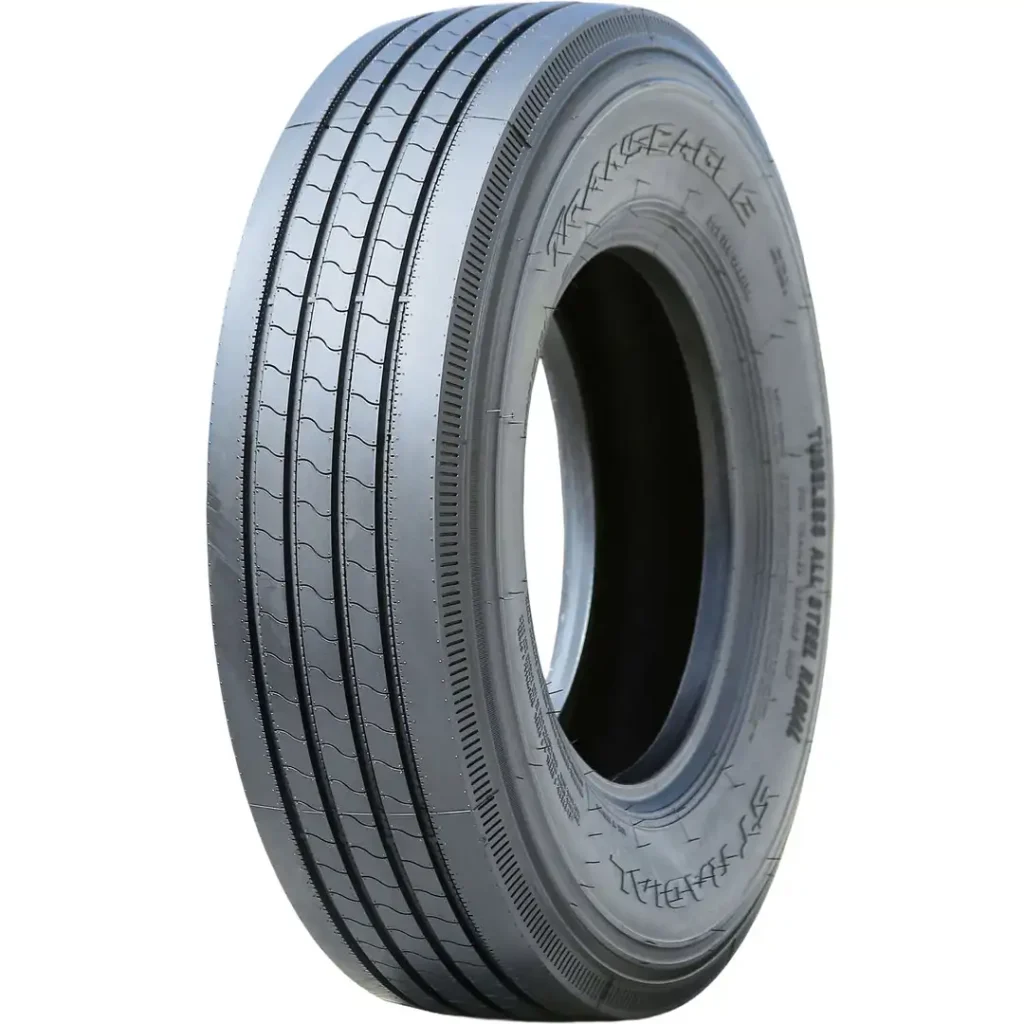
I stumbled on a YouTube video where a guy was applying – his words – “14 ply tires” to his travel trailer.
For those who are not familiar, travel trailers usually come with ST tires. ST tires are uniquely an American sizing system. ST meaning Special Trailer – special, as in not for semi-tractor trailers. Those take regular medium truck tires.
ST tires are usually made of polyester/steel/nylon – polyester body plies, steel belts, and nylon cap plies – and usually go as high as Load Range E (10 PR). So the words “14 ply” caught my attention. I wondered if he was putting MH tires (mobile home) on, which come in half sizes = 14.5″, 17.5″, etc.
Nope!! They were ST225/75R15.
It used to be that ST225/75R15’s only came in Load Range D, but when Goodyear introduced the Endurance series, they added LR E in that size.
Rant!!
The old way of describing load carrying capacity involved “Ply Rating” (PR). I go into more detail here: Ply Strength and Load Range – Barry’s Tire Tech
Short Version: The words “Ply Rating” got shortened to “Ply” and folks frequently confused the rating with the actual number of plies (which can vary in strength) and felt cheated if their tires didn’t have 8, 10, etc actual plies.
To prevent this confusion, the tire industry came up with the term “Load Range”, which come in letters = B, C, D, etc. I am 100% on board with this!
So when someone says “14 ply”, it makes me CRINGE!!
So what are these “14 ply” things??
They are all steel tires made in Thailand. There’s a whole line starting as low as ST205/75 R15 Load Range G.
Question: Since the Load Range is so unusual, did The Tire and Rim Association have this listed? They should have!
Yup! They added it as an asterix.
If this is a thing, are there other brands? Yes, and it appears they are all from the same factory. In the trade, we would call this “green tire interchangeable”. What this means is that while the molds are different, the tire being built and going into those molds is the same.
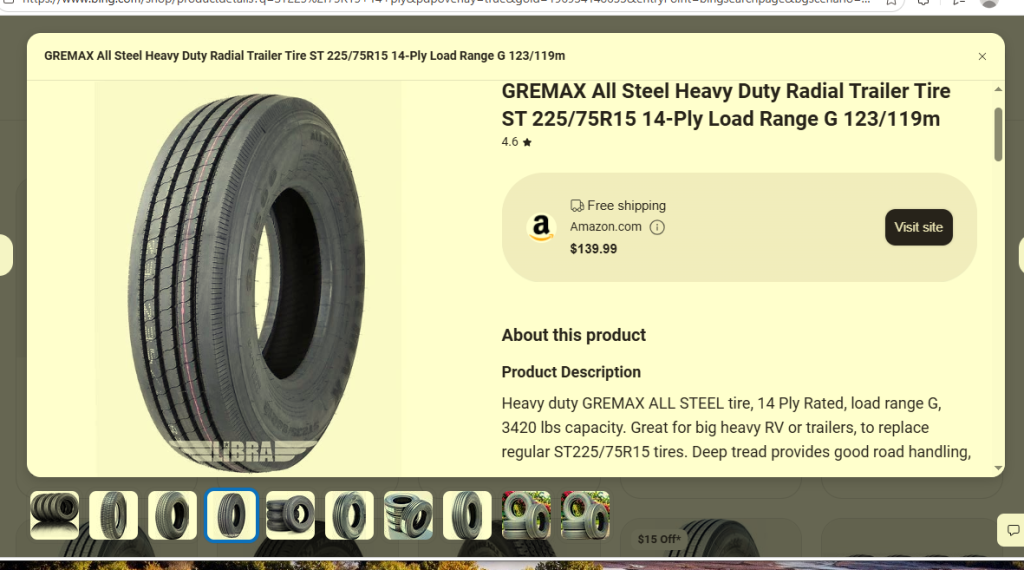
Here are the brands: TransEagle, Suntek, GrandForce, Nebula, Gremax, …… There may be more. There’s a screenshot of one of them below. Notice how the tread pattern is nearly the same as the leadin photo. Except for the sipes, they are the same!!
Thailand?
Maybe I can figure out who is making those?
I looked in Tire Business, a tire industry newspaper who regularly publish statistics, including who has manufacturing facilities where. In Thailand, there are 25 plants for 22 companies. No help there!
Maybe the DOT code? Can’t read any of them!
Why all steel?
All steel means the body plies are steel, as are the normally steel belts. This is a standard construction for a medium truck tire – what is used on 18 wheelers = Semi’s. Usually there are protector belts, also made of steel. I suspect these tires are derivatives of medium truck tires, just made in ST sizes!
Background:
In August of 2000, Firestone was forced by the US government (NHTSA) to recall millions of tires. That sent shock waves through the tire industry and tire manufacturers scrambled to change their products so the risk of failure was as low as they could make it, regardless of the cost. They did passenger car tires first, because that would have the largest impact. Light Truck tires were next. They also intensified the research to improve performance even more! For some reason, niche tires, like ST tires on travel trailers, weren’t included.
By the early 2010’s, it was common for folks with travel trailers to refer to “China Bombs”, as many ST tires were made in China and most brands had high rates of failures. What was really interesting was that these tires had generically American sounding brand names, and disappeared after a few years – to be replaced by another generic brand name tire. In response, many travel trailer owners searched for alternatives – and among those alternatives were LT tires and large P type XL tires.
In the fall of 2017, Goodyear introduced the Endurance series of ST tires, and that fixed the problem. They quickly earned a good reputation! Not that failures were completely eliminated, but the typical tread separation failure common in steel belted radial tires was reduced to such a very small level that those failures could be attributed to factors beyond the manufacturer’s control.
So what does this have to do with these “14 ply” tires?
Some folks think that tires with higher Load Ranges (higher Ply Ratings) are somehow better quality. A subset of those even think that tires are tested for load carrying capacity and the Load Range (PR) is assigned from that test. Actually, the reverse is true – tires are tested to see how well they comply with the Load Range load rating!
Further, it’s the inflation pressure that is the controlling factor here – as the inflation pressure/load relationship determines the deflection – and it is deflection that affects how stressed the tire is and how likely it is to fail in service.
Put another way, a 14 ply (Load Range G) tire run under 10 ply (LR E ) conditions will perform as though it were a 10 ply (LR E) tire. The higher Load Range allows for more inflation pressure – and therefore, more load carrying capacity, but if you don’t use a higher pressure, you’re not using that additional load carrying capacity.
The all steel construction is likely a derivative of a truck tire construction and that is probably what is going on here. This is not a bad thing.
Another interesting aspect is the selling price. At the writing of this page, these all steel LR G tires are 20% to 40% cheaper that the Goodyear Endurance. I suspect the Goodyear price is artificially high because of the high demand. The Goodyears are usually hard to find!
Looking at the selling price of other LR D and LR E ST tires, they are generally another step lower than the LR G being talked about in this article. So, Yes!! The Goodyear’s price seems artificially inflated (Pun intended!)