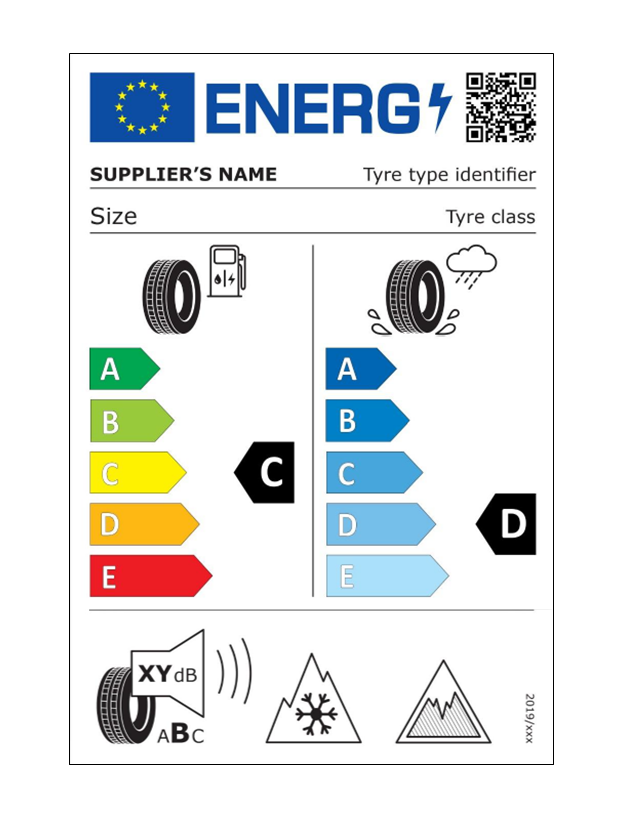
Link to EPREL – The EU’s website that lists EVERYTHING rated with an energy label – including washing machines, air conditioners, ovens ……… and tires!
Here’s a link to the regulation: eur-lex.europa.eu/legal-content/EN/TXT/PDF/?uri=CELEX:32020R0740
And a link to a related document: L_2009200EN.01000101.xml
Please note that below is a discussion on the latest label- revised in 2021. There was a previous version issued in 2012. That version only had the 3 ratings and was only for C1 tires. The 2021 version added C2 and C3 tires as well as added provisions for the Alpine (3PMSF) and Nordic (Ice Grip) symbols. There were also changes to how many rating levels there were.
The important parts first! The 3 ratings!
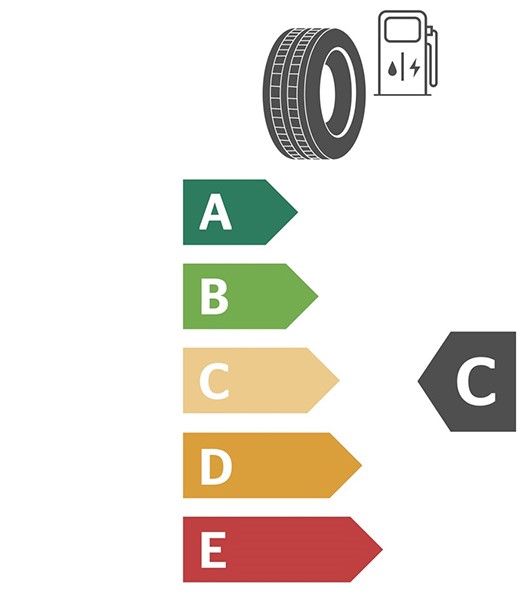
Fuel Economy (Rolling Resistance):
5 categories – A through E, with a rating arrow pointing to the level for the particular tire. Note the multiple colors to help distinguish the grades from each other.
The test is ISO 28580. It’s a single point lab test. It covers all three of the types of tires covered by the regulation. Here’s a link to the test method:
ISO-28580-2009.pdf (The first 8 pages!)
There is a separate procedure utilizing the SRTT (Standard Reference Test Tire) to account for differences between test locations.
Please note that other countries utilize the same rating system in their regulations, although they might use stars, leafs, or numbers instead of letters!
There are grades for 3 kinds of tires:
- C1 = Passenger Car tires
- C2 = Van tires (the European equivalent of LT tires) They sometimes refer to these as Light Duty Commercial tires.
- C3 = Truck/Bus Tires. They sometimes refer to these as Heavy Duty Commercial tires – although, some in the tire industry use the term “Medium Truck tires”. (Heavy Trucks would be those too large to be legally used on highways in the US without special permits – but not big enough to be called Mining Trucks).
The standards are to the right (below).
Please note that RRC = Rolling Resistance Coefficient = RRF (Rolling Resistance Force) ÷ (divided by) the test load.
The test yields a force value (RRF), while RRC has to be calculated. The units are Newtons/kiloNewton. The unit for force is named for Issac Newton.
| RRC Grade | C1 Tires | C2 Tires | C3 Tires |
|---|---|---|---|
| A | Less than 6.5 | Less than 5.5 | Less than 4.0 |
| B | 6.6 to 7.7 | 5.6 to 6.7 | 4.1 to 5.0 |
| C | 7.8 to 9.0 | 6.8 to 8.0 | 5.1 to 6.0 |
| D | 9.1 to 10.5 | 8.1 to 9.0 | 6.1 to 7.0 |
| E | Greater than 10.6 | Greater than 9.3 | Greater than 7.1 |
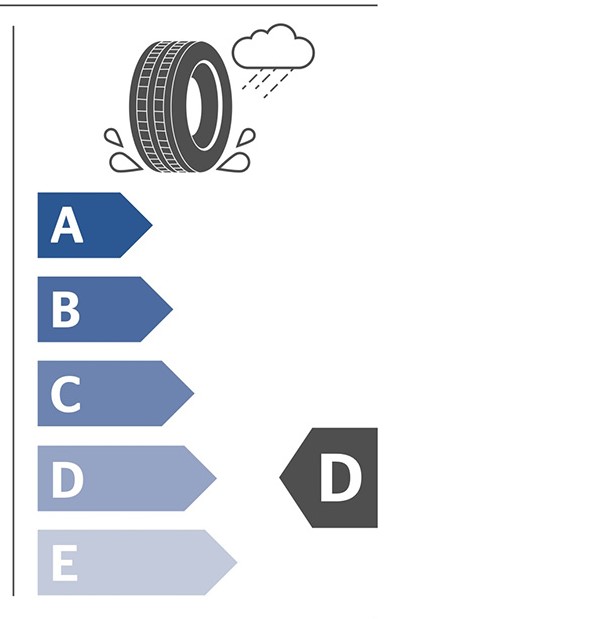
Wet Grip:
5 categories – A through E, with a rating arrow pointing to the level for the particular tire. Note that the colors are all different shades of blue.
The test is ISO 23671. It’s an on-vehicle ABS braking test, testing the stopping distance from 80 kph (50 mph) to 20 kph (12 mph). The reason for 20 kph (12 kph), rather than zero is to avoid some of the weird things ABS systems do at these low speeds! The test is conducted on asphalt with specific characteristics.
Here’s a link to the test method:
ISO 23671:2021 – ISO 23671:2021 (The first 10 pages!)
Please note that there is a version of this test involving the use of a traction trailer.
Also please note that you will find some places on the internet that say the low speed is 5 kph (3 mph), but that is incorrect. The test method calls for 80 to 20 kph! (Which is why I provided a link to the test method!)
The test speeds are such that the effects of hydroplaning are small even for deep water. But the water depth = 1.5mm (0.06″, slightly less than 1/16″). In other words, wet, but well below where hydroplaning takes place!
The test utilizes the SRTT (Standard Reference Test Tire) to account for differences between test locations and test conditions (like the weather).
To the right (below) are the actual grades according to the Wet Grip Index, G.
Please note that the California Energy Commission is proposing that all Passenger Car tires sold in California have at least a G index of 1.00 – which place the worst tires in the lowest class. The effective date of their proposal is January 1, 2028. January 1, 2029.
It is unclear how these grades apply to C2 (Van tires) and C3 tires (Truck/Bus) because of reference to the 16″ SRTT. There are other SRTT’s which would be more appropriate for C2 and C3 tires.
Please note that the index is 25% less than the SRTT for passenger car (C1) tires. I suspect they did that so that the Index would always be greater than 1.00 for passenger car tires. That also means the 16″ SRTT is a Grade C!
| Wet Grip Index Grade | C1 Tires | C2 Tires | C3 Tires |
|---|---|---|---|
| A | Greater than 1.55 | Greater than 1.40 | Greater than 1.25 |
| B | 1.40 to 1.54 | 1.25 to 1.39 | 1.10 to 1.24 |
| C | 1.25 to 1.39 | 1.10 to 1.24 | 0.95 to 1.09 |
| D | 1.10 to 1.24 | 0.95 to 1.09 | 0.80 to 0.94 |
| E | Less than 1.09 | Less than 0.94 | Less than 0.79 |
Another way to look at the Wet Grip Grades!
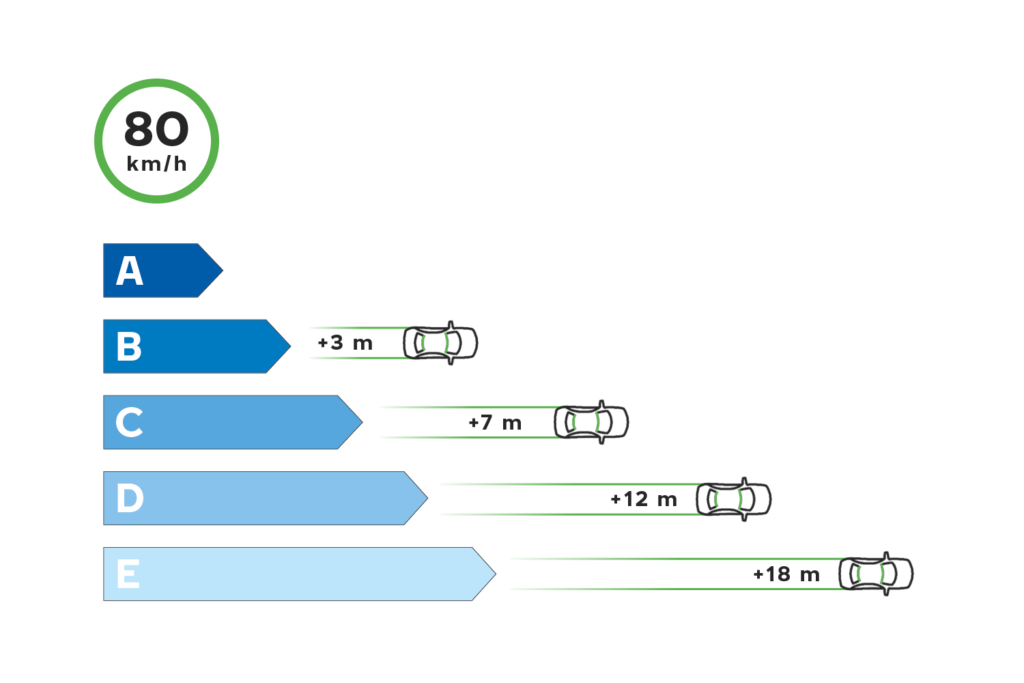
Sometimes the wet grip grades are indicated by the longer stopping distances for the lower grades. I suppose this helps consumers understand, but the engineer in me doesn’t like this.
Nevertheless, here it is:
| Wet Grip Grade | How much longer to stop than a Grade A? |
| B | 3 meters = 10 feet |
| C | 7 meters = 23 feet |
| D | 12 meters = 39 feet |
| E | 18 meters = 59 feet |
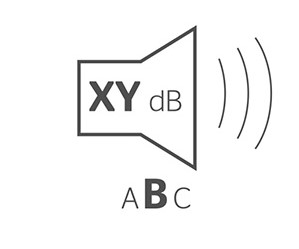
Noise:
3 categories – A through C. The actual rating is bolded (and larger) below the speaker icon. The actual value is indicated inside the speaker icon (“XY” in the diagram to the left (above). Interestingly, this is the only rating where the value is displayed.
BTW, dB is the abbreviation for decibels. It’s a logarithmic scale with a rating of 2 being 10 times as strong as a rating of 1, but the way an ear perceives this, a “2” is twice as loud as a “1”. Normal tire noise levels are around 70 dB.
Also, there are weighting systems for describing sound. “A” is weighted the way humans perceive sound – meaning humans don’t hear very high or very low frequencies. This is usually expressed as dB(A) or dBA
Decibel = one tenth of a Bel – named after Alexander Graham Bell.
The test is a vehicle (engine off) pass-by noise test conducted on asphalt at 80 kph (50 mph) for C1 and C2 tires, and 70 kph (43 mph) for C3 tires. The test surface has specifications that are too involved to describe here, but it’s a form of what we normally call asphalt.
Please note that this test doesn’t define how noisy the tire will be INSIDE the vehicle! That’s because the vehicle could have a lot of insulation.
This is a link to a test method, but this one appears to have limits, not grades! . R117rev.2E
.
C1 tire Noise Grades:
Yes, it’s a bit complex!! It varies by the section width of the tire – the first number in the size
| Tire Section Width | A Grade in dB(A) | B Grade in dB(A) | C Grade in dB(A) |
|---|---|---|---|
| 185mm or less | Less than 67 | 67 to 70 | Greater than 70 |
| 195mm to 215mm | Less than 68 | 68 to 71 | Greater than 71 |
| 225mm to 245mm | Less than 68 | 68 to 71 | Greater than 71 |
| 255mm to 275mm | Less than 69 | 69 to 72 | Greater than 72 |
| Greater than 275mm | Less than 71 | 71 to 74 | Greater than 74 |
C2 tire (Van and LT) Noise Grades:
| C2 tire Noise Grades | Grade A in dB(A) | Grade B in dB(A) | Grade C in dB(A) |
| C2 Normal tires | Less than 69 | 69 to 72 | Greater than 72 |
| C2 Traction tires | Less than 70 | 70 to 73 | Greater than 73 |
C3 tire (Truck/Bus) Noise Grades:
| C3 tire Noise Grades | Grade A in dB(A) | Grade B in dB(A) | Grade C in dB(A) |
| C3 Normal tires | Less than 70 | 70 to 73 | Greater than 73 |
| C3 Traction tires | Less than 72 | 72 to 75 | Greater than 75 |

Snow Traction:
If the tire meets the minimum snow traction level, the use of the symbol to the left (above) is permitted. I like to refer to this symbol as the Alpine symbol, but it is commonly known as the 3PMSF (3 Peak Mountain Snow Flake) symbol.
If the symbol isn’t displayed on the label, the tire likely doesn’t meet the EU criteria. Please note, the use of the symbol is voluntary, so it is possible that some tires that COULD meet the criteria might not display the symbol.
The EU version of the test is an on-vehicle braking test – 25 kph to 10 kph (15 to 6 mph). The acceptance criteria is 107% of the 16″ SRTT.
The North American version is an on-vehicle acceleration test, conducted at 8 kph (5 mph). The acceptance level in North America is 110% of the 14″ SRTT and 112% of the 16″ SRTT. This makes the North American version a bit more stringent than the EU version.
It is unclear how C2 (Van tires) and C3 tires (Truck/Bus) are evaluated due to the different SRTT’s used.
Please note that the symbol, the limits, and the test were designed to define what a “Winter” tire is, but some “All Season” tires can pass the test and are sometimes labeled as “All Weather”. Also some “All Terrain” tires also meet the limits, but have no special designation.
| Snow Grip Index | Brake Test Method | Brake Test Method | Acceleration Test Method | Acceleration Test Method |
| SRTT type | SRTT 14″ & SRTT16″ | SRTT16C | SRTT14″ & SRTT16″ | SRTT19.5″, SRTT22.5″, SRTT19,5″ siped, & SRTT22.5 siped |
| C1 | 1.07 | N/A | 1.10 | N/A |
| C2 | N/A | 1.02** | 1.10 | N/A |
| C3 | N/A | N/A | N/A | 1.25 |
** – This appears to be a mistake!!
Ice Grip:
To the right (below) is the Ice Grip symbol. I like to call it the Nordic symbol as tires that pass this test as more suitable for Nordic countries – as opposed to those countries near the Alps (Alpine).
To qualify, the tire must get 118% of the 16″ SRTT on a smooth ice surface- indoor or outdoor. It is an on-vehicle ABS braking test. Test speed is not specified. The comparison is in deceleration rate.
It is unclear how C2 (Van tires) and C3 tires (Truck/Bus) are evaluated. Best guess is that it hasn’t been established yet (at the time of this article.)

One last item! The QR Code:

This version of the regulation includes a QR code in the upper right hand corner of the label. That should link to a complete listing of the tire in EPREL – the EU site for all the ratings.
What tires are exempt?
- Tires for cars made before October 1, 1990.
- Surely, there must be some tires that fit both before and after the date specified.
- Re-treaded tires
- Motorcycle tires
- Racing/sports car tires
- Studded tires
- Spare tires
- Vintage car tires
- Professional off-road tires
- The word “Professional” means tires whose sole purpose is off road usage!
How does this label compare to UTQG (US) ratings!
Here’s a link to my article on UTQG: Uniform Tire Quality Grading (UTQG) – Barry’s Tire Tech
UTQG was instituted in 1978 and hasn’t been modified since.
UTQG has 3 ratings: Treadwear, Traction, and Temperaure.
The treadwear rating is a numerical comparison to the SRTT = 100, based on a test over a prescribed route. Typical values are 300 to 800.
The traction rating is a sliding wet grip level. This is not at all like the EU label Wet Grip which is an ABS braking test. At the time UTQG was instituted, ABS was very rare and this method made sense- THEN! It no longer does and the author thinks this needs to be revised.
The Temperature rating is more like a speed rating.
Conclusion: UTQG is completely different! There is nothing that can be compared between the 2 systems!
Editorial Comment: I find it very interesting that the EU didn’t mandate a treadwear rating given how important it is to US consumers – and I assume other places! I suspect “NOT INVENTED HERE!” had something to do with it!
I note with interest that the EU has proposed a particulate emission limitation for tires – and I suspect that will be scrutinized and manipulated into a treadwear rating (of sorts!)
And lastly!
I want to acknowledge the clever logo at the top of the label. The word “Energy” is a common term in many European languages, and the absence of the letter “y” (or “ie” common in non-English languages), highlights the letter “G”, which doesn’t change the pronunciation. I love stuff like that!