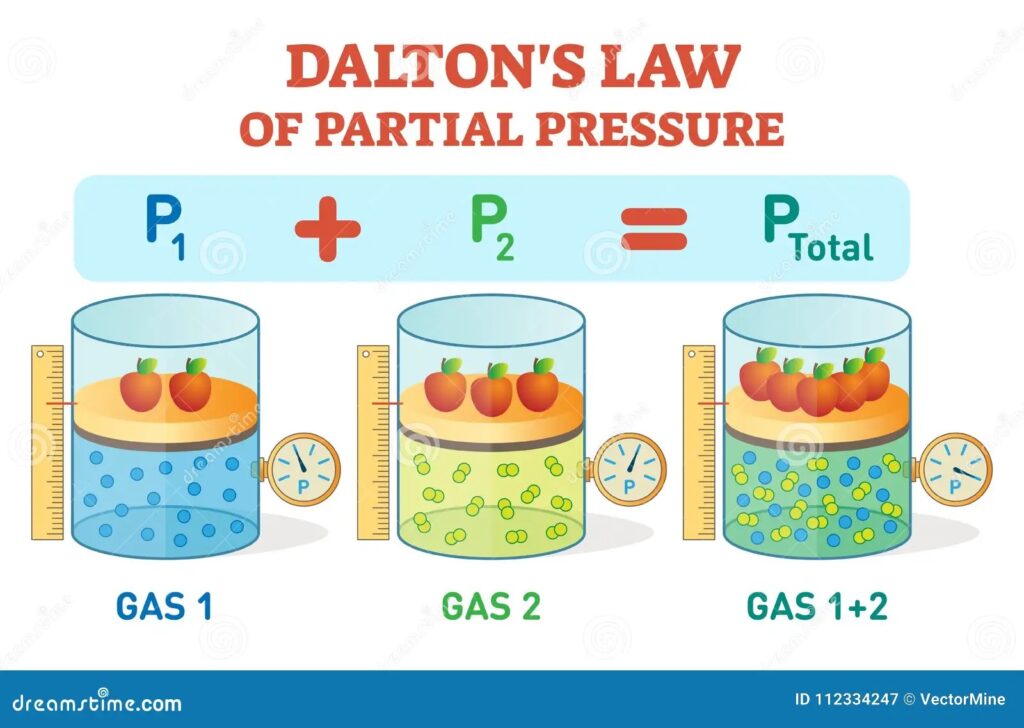
Dalton’s Law says that the total pressure of a gas mixture is the sum of the partial pressures of the individual gases.
John Dalton observed this in 1801. That’s John Dalton to the right (below).
The law is one of several involving gases – and since air is a mixture of gases ……….
Air is about 78% nitrogen, about 21% oxygen, and about 1% of the rest of the gases, including carbon dioxide, argon, etc. That means that the partial pressure of nitrogen at sea level is about 11.5 psi (79 kPa), about 3.1 psi (21 kPa) for oxygen, and about 0.1 psi (0.7 kPa) for the rest (for a total of 14.7 psi= 101kPa)
Just for reference, at sea level, 100% relative humidity, and 77°F (26°C), water vapor partial pressure is 0.5 psi (3.2 kPa). 100% humidity means this is the most that it can be! Otherwise it would be rain (but the air would still be at 100% humidity!)
What is really interesting, this pressure is subtracted from the total pressure, meaning dry air is denser than wet air. (Doesn’t feel like that, does it??)
Further, air pressure due to weather fluctuates between 14.2 psi to 15.2 psi (98 to 105 kPa), but we use 14.7 psi (101 kPa) as the standard.
What does this have to do with tires?
Rubber is ever so slightly permeable – meaning a tire gradually loses pressure over time. AND, the individual gases diffuse though the tire at different rates. The net effect is that the ratio of those gases varies over time. It isn’t a lot, but enough to have fun discussing!
Please note that the seal between the tire and the rim is imperfect – and it varies a lot!. Because of this, tire manufacturers usually quote 1 to 2 psi (7 to 14 kPa) loss per month as “normal”.
And that brings me to the purpose of this article!
One of the oddest things is that oxygen can leak INTO a tire.
Take a tire filled 100% with nitrogen. Over time, due to the partial pressures, oxygen will diffuse through the tire into the tire’s pressure chamber. Yes, I know this sounds counterintuitive.
What this means is that filling a tire with nitrogen doesn’t completely eliminate the effects oxygen has on tire aging. The diffusion rate for oxygen into a tire in this situation is very slow, but it has been measured and the results were presented to the Tire Society, by Don Amos (I used to work with him!), Sept 25, 2007 – Study of Oxygen and Nitrogen Permeation through Tires with Monthly Top-off. Unfortunately, this paper was never published.
BTW, water vapor does this, too!! But usually the water vapor pressure outside the tire is less than what is inside the tire – so most of the time, gaseous water LEAVES the tire – meaning, even if you start with liquid water inside the tire, it will evaporate, leaving the inside of the tire dry.
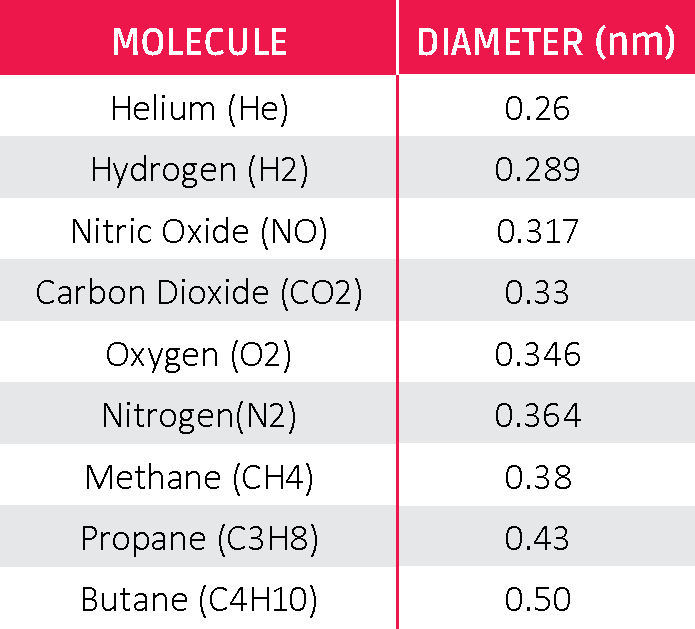
The permeability of gases through rubber is directly related to their kinetic diameter. To the left is a chart showing various gases.
Note that oxygen and nitrogen are very close with nitrogen being 5% larger. That means nitrogen will leak out of a tire slower, but please keep in mind, that they are close!
Some other interesting things:
Halobutyl rubber is 10 to 100 times less permeable than the rubber used in the rest of the tire – which is why it is used on the inside of the tire. This is not to say that the rest of the tire is leaky – just that natural rubber is more so (synthetic rubber, too!).
Please note that butyl rubbers do not mix well with the types of rubber used in tires, so you can’t make a tire out of butyl rubber.
Henry’s Law!
Henry’s Law seems to apply here. It states that in equilibrium the amount of dissolved gas in a liquid is directly proportional to its partial pressure above the liquid.
What that means is that if you have a gas dissolved in a liquid, at the interface, the partial pressure of that gas is the same both above and below the interface – and that means a gas can diffuse OUT of a liquid into, for example, normal air despite the pressure of air (normally 14.7 psi = 101kPa)
This law is frequently cited to explain how our lungs work – with oxygen entering and carbon dioxide leaving at the same time.
While this law is applicable to a liquid/gas interface, it seems to apply to the surface of a tire as well.
It had honestly never occurred to me to connect Dalton’s Law with tires until reading this. Total pressure of a gas mixture being the sum of the partial pressures of the individual gases sounds like pure chemistry-class material, but since air is about 78% nitrogen, 21% oxygen, and roughly 1% everything else, the implications for what’s actually inside a tire become practical fast — for instance, why the oxygen fraction matters for the rubber and rim over time, and why some riders insist on pure nitrogen fills. John Dalton worked this out back in 1801, which is a nice reminder that the physics behind everyday maintenance is old and well settled. Does the partial pressure of oxygen inside a typical passenger tire measurably affect aging compared to a nitrogen fill?
Rozanne,
Thak you for your kind words.
Over the years, many experiments have been tried to better understand tire aging and the one thing that keeps popping up is temperature. What’s even worse, it seems that tire manufacturers have very little they can do to affect the rate a tire ages – except to say that the kind of rubber used has an effect.
Now you would think that filling a tire with nitrogen would have a huge effect on the rate a tire ages, but it seems the fact that the atmosphere has a constant supply of oxygen is by far the most dominant factor. In other words, nitrogen doesn’t seem to be much of a factor.
Hope this helps.
Barry